 Bufetico


If you own Live Nation stock, or worry you’re late to it, you’ve probably learned to tune out the Ticketmaster lawsuits. Ticketmaster is part of Live Nation, people have hated its fees for years, and the stock kept climbing. Felipe Morales didn’t tune them out.
In 2022, Morales, who lives in Montreal, bought four tickets to a Bruce Springsteen concert in New Jersey through Ticketmaster, at $1,000 each. On top of the $4,000, he paid another $599 in fees, about $150 a ticket, MTL Blog reported. In August 2024, a Montreal law firm, Paquette Gadler, sued Ticketmaster on his behalf, as a proposed class action. His lawyers say the fees go up when the ticket price goes up, even though Ticketmaster does the same work either way.
On January 5, 2026, Justice Eleni Yiannakis of the Quebec Superior Court let the case go ahead as a class action, Global News reported. It covers people in Quebec who bought Ticketmaster tickets to shows anywhere in North America since July 2021. No trial date has been reported.
That’s one fan in Quebec. In the US, the fights are a lot bigger. According to NBC News, a federal jury in Manhattan found on April 15, 2026, that Live Nation and Ticketmaster had illegally monopolized ticketing. It also found that Ticketmaster overcharged fans $1.72 a ticket at major concert venues. Live Nation had already settled with the Justice Department during the trial, but the states that didn’t settle still want the judge to make it sell Ticketmaster.
In a separate case in California, the Federal Trade Commission and seven states say Ticketmaster took in $3.7 billion in resale fees from 2019 to 2024, Digital Music News reported. A judge refused to throw that case out in September 2026, and on October 27 the FTC asked for a jury trial. Live Nation denies the claims in both cases.
Where the lawsuits show up in Live Nation’s numbers
So far, mostly in one line. In the first half of 2026, Live Nation booked $450 million as its best estimate of what the settlement with some of the states and the jury’s damages award will cost, its report for the quarter that ended in June 2026 says. It says the verdict is legally flawed and that it plans to appeal. The FTC case isn’t on its books at all, because Live Nation doesn’t see a loss there as probable yet.
Live Nation, one question at a time
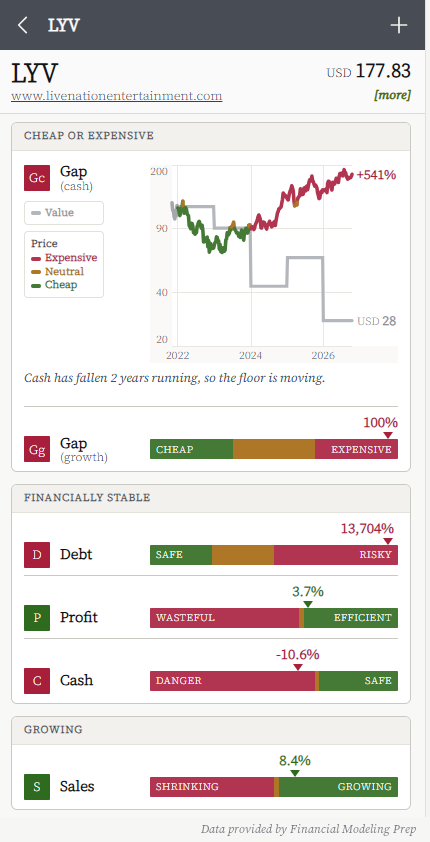
With any company, I do what you’d do with a used car. I look at the engine and the rust first, and the price tag last. My method asks three things in that order: is the company financially stable, is it growing, and is the price cheap or expensive.
Live Nation owes a lot. At the end of June 2026 it had $9.3 billion of debt, against $756 million of equity, the owners’ share on the books. Only $82 million of that belonged to Live Nation’s own shareholders. The rest belonged to partners in businesses it only partly owns.
The cash looks big on paper. At the end of June it had $9.1 billion. But fans had already paid $6.4 billion for shows that hadn’t happened yet, and $1.9 billion of the cash belonged to venues and other clients waiting to be paid. Getting paid before the show is a good business to be in. Still, Live Nation has to put on those shows, and it won’t keep most of that money.
In 2025, its operations brought in $1.395 billion of cash. It spent $1.062 billion on property and equipment, most of it in the concerts business, so it kept $334 million, down from about $1.08 billion the year before. It also paid its people $155 million in stock. That doesn’t cost cash, but each new share gives the owners a smaller piece, so I subtract it. That gets me to about $178 million.
In Bufetico, the debt and the cash come out red. Live Nation’s profit on the money it puts to work comes out green, and so do its sales, up 9 percent in 2025 to $25.2 billion.
Then I look at the price. On October 29, 2026, Live Nation closed at $177.83 a share. With 235.6 million shares, the whole company was priced at about $41.9 billion. That’s about 126 years of the $334 million it kept in 2025, and even longer once I take out the stock pay. Bufetico looks at the price from two sides. The Gap (cash) puts the price next to the cash the company brings in each year, and the Gap (growth) puts it next to how fast it grows. For Live Nation, both are red, and red means expensive.
Where this breaks
2025 was a heavy building year. Live Nation’s spending on property and equipment jumped from $647 million to $1.062 billion, much of it to build and upgrade venues. If that spending comes back down, the cash it keeps goes back up. But even next to the $1.08 billion it kept in 2024, the price comes to about 39 years of that cash. And the Gap (growth), which gives the company credit for growing, is red too.
The lawsuits aren’t why the price looks high to me. Live Nation set aside $450 million, about 1 percent of what the whole company is priced at. The debt does that, and so does how little cash it kept next to its price.
Even the verdict could change. The jury didn’t say how many tickets the $1.72 applies to, and the judge still has to rule on Live Nation’s motions before anything is final. Morales’s case is at an early stage. Letting a class action go ahead doesn’t mean a court has found the fees are unfair. And his ticket details come from one local news site.
Morales’s $599 and a table near the back of the annual report
Near the back of Live Nation’s annual report for 2025, a table splits the company into its businesses. Concerts, the shows themselves, brought in $20.9 billion of sales. Ticketing brought in $3.1 billion. Ticketing counts only its fees as sales, while the concerts count the whole ticket, and a big part of that goes to the artists.
Then there’s the profit. Live Nation grades its own businesses with a measure it calls adjusted operating income. It’s counted before interest, taxes, the wear on its buildings and head-office costs. Ticketing made $1.13 billion. The concerts made $687 million. The part that sells the tickets made more than all the concerts put together, and more than the third business, sponsorship and advertising, which made $845 million. That’s the business Morales, the states and the FTC are all fighting over.
When I open Live Nation in Bufetico, the three answers come up on one screen.
If I owned Live Nation, I’d circle November 5, 2026, the day it has scheduled its next quarterly report. The note on legal matters would tell me if the judge in Manhattan has ruled on the verdict, and if the $450 million estimate moved. I’d put Ticketing’s adjusted operating income next to the same quarter a year earlier. And in the cash flow statement, I’d take the cash from operations, subtract the spending on property and equipment and the stock pay, and check if what’s left is bigger or smaller than a year earlier.
Say you bought Live Nation because the arenas are full every summer. A headline about breaking up Ticketmaster tests you. That’s the day people dump a business that hasn’t changed, or decide their whole method needs a fix. It’s like a soccer player who spends months in the gym before the season, so his legs still have something left in the 90th minute. I train my emotional muscle on the small drops that never make the news, so I can hold on through a headline like that. No company gets a bigger slice of my account than the others, so a ruling against any one of them only hits a small piece of it.
If you own Live Nation or you’re about to buy it, its sales keep growing and its fees make real money. But it owes a lot, and the cash it kept in 2025 was small next to its price. To me that’s expensive, whatever the courts decide.
The lawsuits you learned to tune out all go after Ticketmaster, the part of Live Nation that made the most profit in 2025.
Key factsThe numbers and where they come from · 30 October 2026
- In 2025, Live Nation’s operations brought in $1.395 billion of cash. It spent $1.062 billion on property and equipment, which left $334 million, and it booked $155 million of pay in stock (annual report for 2025).
- In 2025, Ticketing brought in $3.1 billion of Live Nation’s $25.2 billion in sales and $1.13 billion of adjusted operating income. Concerts brought in $20.9 billion of sales and $687 million of adjusted operating income (annual report for 2025).
- At the end of June 2026, Live Nation had $9.3 billion of debt and $756 million of equity, of which $82 million belonged to its own shareholders. It booked $450 million for the settlement with some states and the jury’s damages award (report for the quarter that ended in June 2026).