 Bufetico
Six layers, one list, no noise. Investing for people with lives.
Recorded demonstration. The companies in it met the filter settings used on the day it was recorded, not today. Nothing shown is a recommendation.
Weeks later it was down, and you couldn't tell why. I've been investing since 2000 and teaching since 2010, and with close to a thousand students I've seen this happen over and over. All we ever hear is that you need a strong stomach to invest. I call that strong stomach the emotional muscle. Most of us don't even know it exists, so we never train it. And three things keep knocking us off course.
That emotional muscle is under all three, and you train it like any muscle at the gym, with a routine of sets and reps. Your brain builds new connections when you give it the right dose of intensity, frequency and repetition.
So I took a simple method and built it into a filter. It leaves the news out, keeps the same six layers every day, and shows you at a glance whether a good company is cheap or expensive.
A simple method, a trained emotional muscle, patience and discipline. With those four, you don't need the news or the rest of Wall Street.
Bufetico measures every listed company it can reach, more than 30,000 of them, across more than 30 exchanges from New York to Tokyo, Shanghai, Mumbai, Madrid and São Paulo, and reduces each one to six numbers.
You move six sliders to say what you consider cheap, stable and growing. Bufetico returns the companies that meet all six at once. No lists of picks, no opinions: you set the criteria, it does the arithmetic. Once the sliders are where you want them, leave them alone, even when some of the companies that get through go down.
When a number is missing, or the measure does not apply to that company, the square stays gray. It is never filled in with an estimate. A blank tells you where to look. A guess tells you nothing.
Every number comes from audited annual accounts and official closing prices. The price and the two Gaps update as each exchange closes, debt and return on capital every week, and the rest once a month.
The two Gaps work out what the business is worth, each one a different way, and compare it with the price.
Debt, profit and cash show you if the company can ride out a crisis, fight off the competition and keep innovating.
Sales show you if the company is growing, even a little.
I have always thought the companies that end up worth more over the years are the ones that grow and stay stable, and the numbers back that up. But that does little for me unless I buy when a company is cheap and get out when it is expensive. In between, I might hold the company for years, so I need patience.
You get the six layers of each company, worked out from its own annual reports and its closing price. Headlines and hot stocks stay out, so a lot of the noise never gets to you.
On Monday mornings you get an email or a phone notification if a new company gets into your filter. The rest of the week, you live your life.
Connect your broker's account and Bufetico can see your positions. It can't buy, sell or move a cent.
It opens in your browser and sits on your home screen. There's nothing to download from an app store.
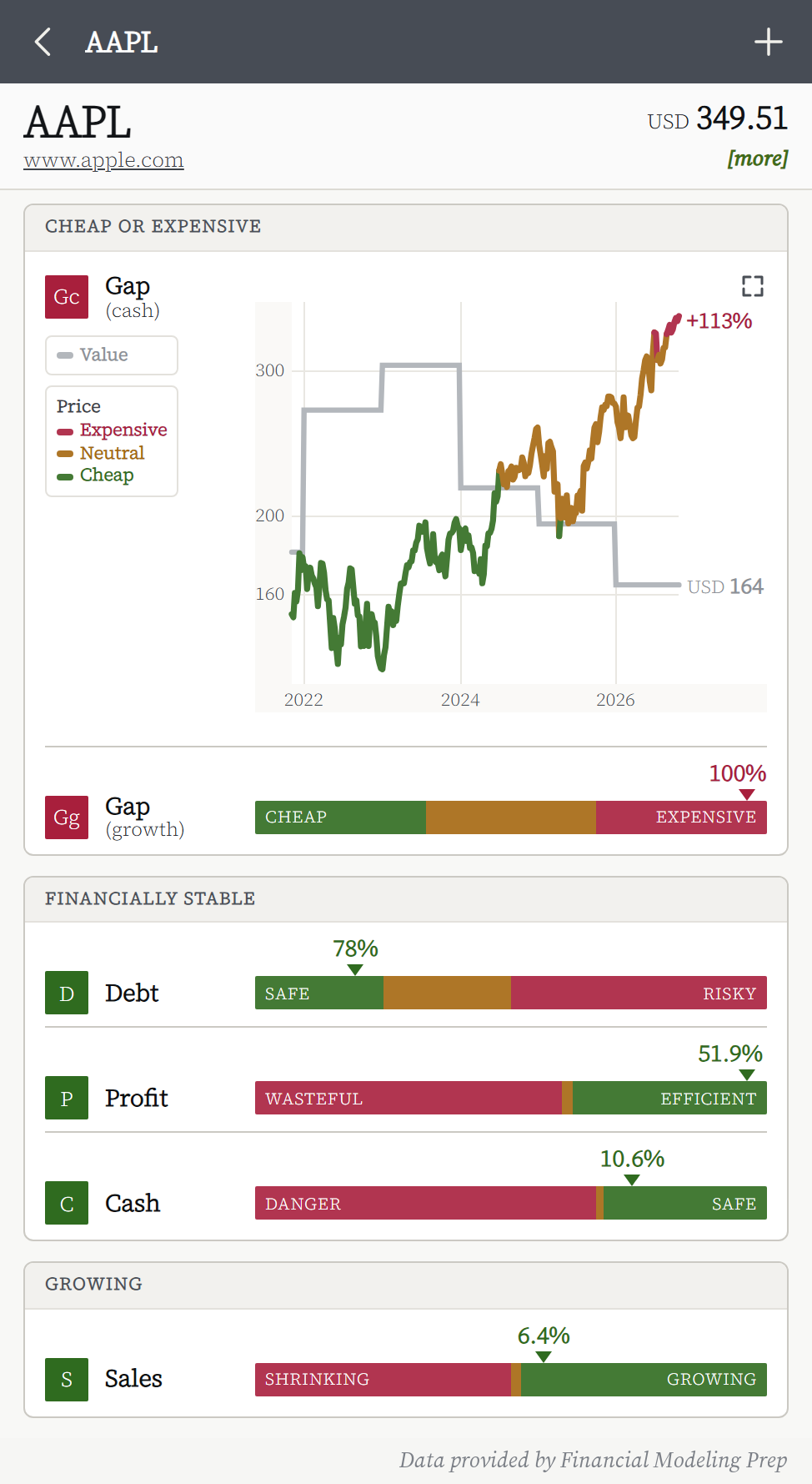
This is Apple in Bufetico after the close on November 4, 2026. The gray line is what Apple is worth, going by the cash it brings in each year. The colored line is the price. Below the gray line it's green. Above it, it turns amber, then red the higher it climbs.
Apple is stable and growing. Its debt, profit, cash and sales are all green. The two Gaps are red, and the price is way above the gray line, so to me it's a solid company that's expensive today.
If you own Apple, there isn't much you need to keep up with. Open its next annual report and read the cash it brought in over the whole year. A new annual report is what moves the gray line.

Every case on the blog and every lesson of the course starts from a company's own filings, and all of it is free to read before you pay for anything.
A screener only does arithmetic. Reading the company behind the numbers is your part, so I am writing a free course on it. It runs to five modules, and every lesson starts from a real company's own filings.
 20 November 2026 · JH Grandgerard · 8 min read
33 free tools for stocks, retirement and everyday money. They work on the web today, with no sign-up, and they’re coming to the Bufetico app.
Bufetico is an information tool, not investment advice. We are not a broker or an investment adviser, and nothing here is a recommendation to buy or sell anything. Every decision you make is your own.