 Bufetico
If you own Tesla stock, or you’re about to buy it, you’re paying for what Tesla could be in ten years, the robotaxis and the robots. It’s easy to miss the door handles on a 2021 Model Y. Jacquelyn Tremblett’s son died in one of those cars, and her lawsuit says he couldn’t get out.
A little after 1 a.m. on October 29, 2025, Samuel Tremblett was in a Tesla that ran off Route 138 in Easton, Massachusetts, south of Boston. It hit a tree and caught fire. He called 911 and said he was stuck inside the burning car, The Boston Globe reported. When the fire was mostly out, he was found in the back seat. He was 20. He studied design at Syracuse University, and in 2024 he started his own clothing line, his obituary says.
In February 2026, his mother sued Tesla in federal court in Boston, saying the car’s “unreasonably dangerous design” caused his death. The car was a 2021 Model Y, the lawsuit says. A Model Y opens its doors with an electric button. When a crash cuts the power, you need the manual releases, and the lawsuit says they’re hard to find. In the back, you take a mat out of the door pocket and pull a tab, and the owner’s manual pages in the lawsuit say not every Model Y has a release back there, Gizmodo reported. The complaint counts at least 15 people who died in the past decade trapped in Teslas whose electric doors wouldn’t open, the Globe reported.
“They could have fixed it, but they refused,” Jacquelyn Tremblett said. Before she sued, her lawyer sent Tesla a letter asking for $25 million, and the lawsuit says Tesla hadn’t replied, WPRI reported. Tesla didn’t respond right away to the Globe or to WPRI.
The doors were in the news before that night. In September 2025, the federal car safety agency opened an investigation into reports that the outside door handles on about 174,000 Model Ys from 2021 stopped working when the car’s low-voltage battery ran down, CBS News reported. Most of the complaints came from parents who couldn’t get back in to reach a child in the back seat. The next day, Tesla’s chief designer, Franz von Holzhausen, told Bloomberg that Tesla was working on putting the electronic release and the manual one into a single button. Doing that “makes a lot of sense,” he said, TechCrunch reported.
China moved faster. Its industry ministry said in February 2026 that new cars there must have a mechanical release on every door, inside and out, starting January 1, 2027, and the Model Y is among the cars that could be affected, the Associated Press reported. In the United States, the agency said in July 2026 that it would write new rules for door releases. Those would only cover cars built from then on, Electrek reported.
The cash Tesla keeps
In 2025, Tesla’s operations brought in $14.747 billion of cash, its annual report shows. It spent $8.527 billion on property and equipment, so it kept $6.22 billion. What Tesla keeps has gone up and down. It fell in 2023 and again in 2024, to $3.581 billion, about half of what Tesla kept in 2022. In 2025 it came back.
Then 2026 went the other way. In the first nine months, Tesla’s operations brought in $14.897 billion, but it spent $13.014 billion on property and equipment, more than twice as much as a year earlier. So it kept $1.883 billion, its third-quarter report shows. The cash coming in was more than in all of 2025. What shrank is what was left after the spending. Tesla expects that spending to top $20 billion in 2026, for things like computing power, data centers and factories.
Tesla also paid its people $2.825 billion in stock in 2025. That costs no cash, so the cash flow statement adds it back. I still count it, because each new share thins out the slice of whoever already owns Tesla. Count it, and what Tesla kept in 2025 drops to $3.395 billion. In the first nine months of 2026, the stock pay was $3.346 billion, more than the $1.883 billion Tesla kept, so by my count it came up about $1.463 billion short.
What I ask before the price
With any company I go in the same order. Is it financially stable, meaning it owes little, makes a good profit on the money it puts to work, and brings in cash? Is it growing, even a little? I only look at the price after that.
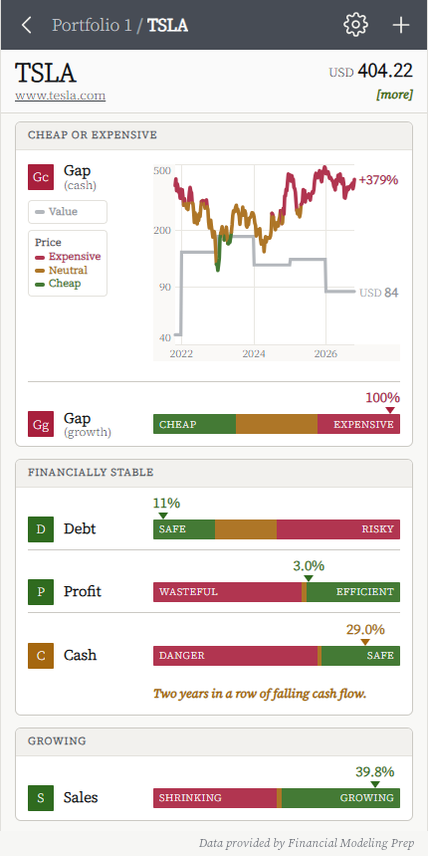
Tesla has far more cash than debt. At the end of September 2026, it had $9.523 billion of debt and finance leases, and $45.447 billion in cash and short-term investments. In Bufetico, its debt and its profit come out green. Its cash flow comes out orange, and Bufetico writes the reason under it: two years in a row of falling cash flow, in 2023 and 2024.
Talking about growth costs a CEO nothing, so I wait until I see it in the sales line of the annual report. Tesla’s sales slipped in 2025, to $94.827 billion from $97.690 billion. In the first nine months of 2026 they were 12.5 percent higher than a year earlier. Over the last five years they’ve grown a lot, so in Bufetico the sales come out green.
On October 28, 2026, Tesla closed at $404.22 a share. As of October 15, there were about 3.95 billion shares, so the whole company was priced at about $1.6 trillion. That’s about 257 years of the cash Tesla kept in 2025, before taking out the stock pay. In Bufetico, the Gap (cash) puts the price next to the cash Tesla brings in each year, and the Gap (growth) puts it next to how fast Tesla grows. Both are red, the color Bufetico uses for expensive. Bufetico’s chart of the Gap (cash) shows Tesla cheap or in between for parts of 2022 and 2023.
Where this breaks
Judging Tesla by one year of cash is hard on a company spending more than $20 billion in a single year on what it hopes comes next. If what it’s building pays off, the cash it kept in 2025 will look small. That’s why Bufetico also puts the price next to how fast Tesla grows. Sales are growing, but the price runs ahead of even that growth, so that side is red too.
The 3.95 billion shares include about 424 million restricted shares from Elon Musk’s 2025 pay award, and he only keeps them if he stays and Tesla hits targets for its market value and its operations. Leave them out, and the price is still about 229 years of the cash Tesla kept in 2025.
Jacquelyn Tremblett’s side comes from her lawsuit and from news reports, and no court has ruled on it. The Model Y does have manual releases, at least on the front doors, and her lawsuit says they’re hard to find. Back in October 2025, the district attorney’s office said the crash didn’t look suspicious and that it was investigating. And in July 2026, the federal safety agency turned down a request to investigate the hidden releases on 2022 Model 3s as a defect, saying it found one matching complaint, Electrek reported.
Samuel Tremblett’s Model Y and one line in Tesla’s annual report
Tesla’s annual report has a part about risks, and there Tesla says that in most places it insures itself against product liability claims over its cars. In Tesla’s words, those claims “will likely have to be paid from company funds and not by insurance.”
In August 2025, a federal jury in Miami found Tesla 33 percent at fault for a 2019 crash involving Autopilot, its driver assistance system, and awarded $200 million in punitive damages. Tesla appealed. Its report for the quarter that ended in September 2026 says it has set aside an amount for the case that it calls immaterial, meaning too small to matter in its accounts.
One case won’t dent $45 billion in the bank. But whatever Tesla pays on claims like Jacquelyn Tremblett’s, if it pays anything, will most likely come out of the same cash flow I counted above, the one that came up short in 2026.
Bufetico puts my three questions about Tesla on one screen.
If I had Tesla in my portfolio, I’d wait for its annual report for 2026, which usually comes out in late January. In the note on legal proceedings, I’d look at where the Miami appeal stands and whether any door cases show up by name. Then, in the cash flow statement, I’d take the cash from operations, take away the spending on property and equipment and the stock pay, and compare what’s left with the $3.395 billion from 2025.
Tesla can drop 20 or 30 percent in a bad stretch, and when it’s your money, the drop is all you can see. That’s when people bail on a good company, or decide the method they had was wrong. You don’t walk into a gym and bench 100 pounds on day one. You start with 50, add a little weight every week, and months later the 100 feels like something you’ve lifted before. Emotional muscle grows the same way, one smaller drop at a time that you sit through. And it has to grow with the money, because a $10,000 position and a $500,000 one go through the same drop but don’t weigh the same in your gut. However famous a company is, it gets about the same slice of my account as every other one I own.
If you own Tesla or you’re thinking about buying it, it’s a company that owes little, has plenty of cash in the bank and has grown its sales a lot over the years. But the cash it keeps fell in 2023 and 2024. In the first nine months of 2026, under all that spending, it kept $1.883 billion, and came up short once I count the stock pay. Its price is way up there compared to the cash it brings in each year, and compared to how fast it grows. To me that’s expensive.
If you own Tesla for the robotaxis, the cars it already sold still come with claims like the one over Samuel’s death, and Tesla says it will likely pay those from its own funds.
Key factsThe numbers and where they come from · 20 November 2026
- In 2025, Tesla’s operations brought in $14.747 billion of cash. It spent $8.527 billion on property and equipment, which left $6.22 billion, and it booked $2.825 billion of pay in stock (annual report for 2025).
- After paying for property and equipment, Tesla kept $3.581 billion in 2024 (annual report for 2025). In the first nine months of 2026 it kept $1.883 billion, after spending $13.014 billion, and it expects that spending to top $20 billion in 2026 (third-quarter report).
- Tesla’s annual report for 2025 says that in most places it insures itself against product liability claims over its cars, so any it pays will likely come from company funds and not from insurance (annual report for 2025).
- Jacquelyn Tremblett sued Tesla in federal court in Boston in February 2026 over the death of her son, Samuel, 20, in a 2021 Model Y that crashed and caught fire in Easton, Massachusetts, on October 29, 2025 (The Boston Globe; Gizmodo).