 Bufetico

If you own Arm stock, or you watched it more than quadruple between January and June 2026 and wondered if you’d missed it, you’ve seen it give back almost half since then. Maybe you held on because SoftBank owns most of Arm, and an owner that big looks like the steadiest one a stock could have. On December 1, 2025, Arm’s chairman, Masayoshi Son, told a forum in Tokyo that he cried when SoftBank sold its Nvidia shares.
Son founded SoftBank, still runs it and chairs Arm’s board. SoftBank owned 86.4 percent of Arm in May 2026, Arm’s annual report says. In November 2025, SoftBank said it had sold all of its Nvidia shares, and in Tokyo Son explained why: “I just had more need for money to invest into OpenAI, invest into our opportunities, so I was crying to sell Nvidia shares,” Business Insider reported. He said he’d have kept them if he’d had more money.
SoftBank has also borrowed against its Arm shares since 2022, and its current loan dates from August 2023. In September 2026, Bloomberg reported that SoftBank had raised that loan by $5 billion, to $25 billion. It was the third increase, and SoftBank declined to comment on it.
Arm’s annual report spells out what the lenders hold: 769,029,000 Arm shares, 72.0 percent of the company. If Arm’s price falls below certain levels, SoftBank may have to pay back some or all of the loan early or put up more collateral. To raise the money, it may decide to sell some of the pledged shares, and if the loan isn’t paid, the lenders can sell them too. Sales like that could push Arm’s price down, the report says. It also says Arm itself has no significant obligations under the loan.
What Arm sells, and how fast it grows
Arm designs the main processor in a chip, and companies like Qualcomm pay to use those designs, or just the rules the designs follow, in their own chips. Arm gets paid twice, a fee when a company licenses a design and a royalty on each chip made with it. More than 350 billion chips built on Arm’s designs had shipped by March 2026, the company says.
Arm’s sales were $4.920 billion in fiscal 2026, the year that ended March 31, 2026, 23 percent more than the year before. In the quarter that ended in June 2026, they were 22 percent higher than a year earlier, its report for that quarter shows.
The three questions I ask about Arm
With any company, the price is my last question. Before it, I want to know two things. Is the company financially stable, meaning it owes little, makes a good profit on the money it puts to work and brings in cash? And is it growing, even a little?
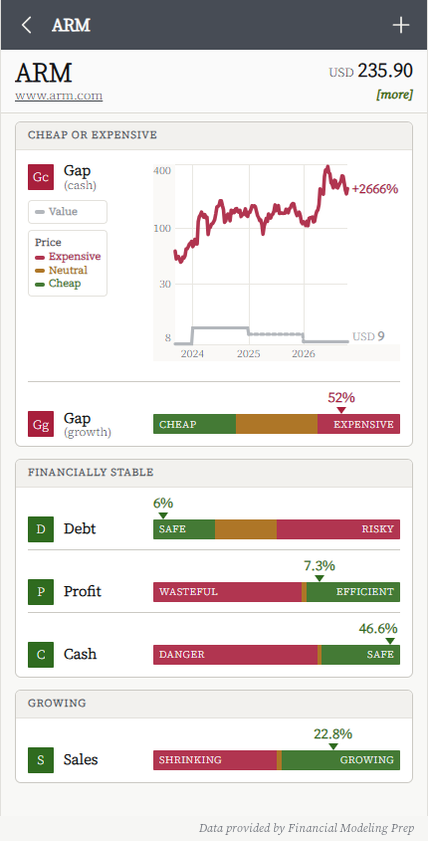
Arm has no loans, and at the end of June 2026 it had $3.058 billion in cash plus $830 million in short-term investments. Under the accounting rules, it made $900 million running the business in fiscal 2026, and that’s after counting what it paid its people in stock as a cost. In Bufetico, its debt, its profit, the cash it brings in and its sales all come out green. To me, that’s financially stable and growing.
Even with the cash in green, I slow down there. Arm’s operations brought in $1.524 billion of cash in fiscal 2026. It spent $545 million on property and equipment, as it expanded its data centers and offices, so it kept $979 million. No cash leaves the company when it pays people in shares, so the cash flow statement adds that cost back. I count it anyway, because if Arm paid those people in cash, that money would be gone. The stock pay came to $1.052 billion that year, more than all the cash Arm kept. Subtract it, and Arm came out $73 million short. Part of the reason is sales Arm had booked but hadn’t collected yet.
On October 28, 2026, Arm closed at $235.90 a share. There are about 1.068 billion shares, so the whole company was priced at about $252 billion. That’s about 257 years of the cash it kept in fiscal 2026, even before taking out the stock pay. In Bufetico, the Gap (cash) compares the price with the cash Arm brings in each year, and the Gap (growth) compares it with how fast Arm grows. For Arm, both are red, which means expensive.
Where this breaks
One year of cash is a hard yardstick for a company whose sales grow more than 20 percent a year, and fiscal 2026 was held back by those sales Arm hadn’t collected. Over the 12 months that ended in June 2026, Arm kept $1.506 billion, and the price is about 167 years of that. Take out the stock pay and what Arm kept falls to $352 million. The Gap (growth) is there for companies like this, and it’s red too.
Son’s words come from one forum, the way Business Insider reported them, and the $25 billion comes from Bloomberg’s unnamed sources. At the October 28 price, the pledged shares were worth about $181 billion, more than seven times that loan. And a falling price doesn’t have to end in a sale, because SoftBank can put up more collateral, the annual report says.
Son’s SoftBank, and a note on related parties in Arm’s annual report
SoftBank also shows up in Arm’s sales. Under a consulting agreement, Arm licenses technology to a SoftBank affiliate and gives it technical advice. That affiliate brought Arm $704.4 million of sales in fiscal 2026, up from $145.5 million the year before, the note on related parties says. That’s about $559 million of the $913 million Arm added in sales that year. Take the affiliate out, and the rest of Arm’s sales grew 9 percent, not 23.
At the end of March 2026, Arm hadn’t billed $645.8 million of what it had booked from that affiliate. In the quarter that ended in June 2026, the affiliate brought in another $192.9 million, and Arm’s sales from all its other customers grew 18 percent, twice as fast as in fiscal 2026.
In Bufetico, all three answers for Arm fit on one screen.
If I owned Arm, I’d open its report for the quarter that ended in September 2026, which Arm said it would release on November 4, 2026. In the note on related parties, I’d see how much of the sales came from the SoftBank affiliate and how much of it Arm hasn’t billed or collected. Then I’d go to the cash flow statement, take the cash from operations, subtract the purchases of property and equipment and the stock pay (the statement calls it share-based compensation cost), and put what’s left next to the same quarter a year earlier. And in the note on legal matters, I’d check whether the federal judge in Delaware hearing Qualcomm’s lawsuit has ruled on its request to stop paying Arm royalties for up to five years.
A drop like Arm’s since June hurts most when it’s your own money, because it feels like proof you were wrong. That’s when you bail out, or start rewriting a method that was working. A boxer takes punches in sparring for months before a real fight, so the first hard one doesn’t make him drop his hands. Holding through a big drop takes emotional muscle, and I build it the same way, by sitting through smaller drops first. I also never want to be in Son’s spot with a company I like. So the money I put in stocks is money I won’t need by a certain date, and I keep every position about the same size, no matter how famous the company is.
If you own Arm or you’re about to buy it, you’re looking at a company that owes nothing, makes a profit under the accounting rules and keeps growing. But in fiscal 2026 a big part of that growth came from an affiliate of its own owner, the stock pay was bigger than all the cash Arm kept, and its price is far above what Arm is worth going by the cash it brings in each year and how fast it grows. To me that’s expensive. I like buying good companies the way people buy winter coats in July, when the coat is the same and the line is empty. With Arm, the line goes around the block.
You probably figured an owner with 86.4 percent of Arm was the safest thing about the stock. Most of those shares are collateral for SoftBank’s loan.
Key factsThe numbers and where they come from · 13 November 2026
- In fiscal 2026, which ended March 31, 2026, Arm’s operations brought in $1.524 billion of cash. It spent $545 million on property and equipment, which left $979 million, and it booked $1.052 billion of pay in stock (annual report on Form 20-F).
- In fiscal 2026, Arm’s sales were $4.920 billion, 23 percent more than a year earlier. Sales to an affiliate of SoftBank under a consulting agreement were $704.4 million, up from $145.5 million, and at the end of March 2026, $645.8 million of it hadn’t been billed yet (annual report on Form 20-F).
- In May 2026, SoftBank owned 86.4 percent of Arm, and 769,029,000 Arm shares, 72.0 percent of the company, were pledged as security for a SoftBank margin loan (annual report on Form 20-F).
- In the quarter that ended in June 2026, Arm’s sales were 22 percent higher than a year earlier, and $192.9 million of them came from the SoftBank affiliate (first-quarter report on Form 6-K).