 Bufetico

If you own CrowdStrike stock, or you’ve watched it climb in 2026 and wondered if you missed it, the July 2024 outage probably feels like old news. CrowdStrike kept growing right through it. Julio del Rio slept on airport benches because of it, and he’s still in court.
In July 2024, del Rio and his wife were trying to get out of Kona, on Hawaii’s Big Island, when a bad update to CrowdStrike’s security software crashed about 8.5 million Windows computers, by Microsoft’s count. At the airlines, it hit the systems they use to check in passengers and to figure out how much a plane weighs, his lawsuit says. Delta alone canceled about 7,000 flights over five days, its report for that quarter says.
Del Rio spent about $1,200 on new tickets for himself and his wife. During an 11-hour delay in Kona that ran through the night, he slept on airport benches or on the floor. In all, he got home 17 hours late, View from the Wing reported on September 23, 2026. His lawsuit says he also had to use a day of paid time off for the work he missed.
In August 2024, del Rio and two other passengers sued CrowdStrike in federal court in Texas, as a proposed class action, and others joined them later. One of them, Jennie Aguayo, says her delay in Hawaii left her with anxiety, chest pains and headaches. They all wanted their costs back, things like new tickets, hotels, meals and Uber rides. CrowdStrike asked the judge to throw the case out, and in June 2025 he did. His reason was the Airline Deregulation Act, a 1978 law that keeps states from regulating airlines’ prices, routes and service. He found the passengers’ claims were related to airline service, even though CrowdStrike doesn’t fly anybody. In May 2026, the federal appeals court in New Orleans agreed with him. On September 14, 2026, del Rio and the other passengers asked the Supreme Court to take their case.
Delta, a CrowdStrike customer, got further. It sued CrowdStrike in Georgia state court, and in May 2025 a judge there let part of its case go ahead. Both sides are still gathering evidence, CrowdStrike’s report for the quarter that ended in July 2026 says.
Where the outage shows up in CrowdStrike’s numbers
The totals barely show it. In fiscal 2026, the year that ended January 31, 2026, CrowdStrike sold $4.812 billion, 22 percent more than the year before, its annual report shows. In the quarter that ended in July 2026, its sales were 26 percent higher than a year earlier.
After the outage, CrowdStrike gave its customers what it calls customer commitment packages, with discounts, extra modules, flexible payment terms and longer subscriptions. It says the packages have cut into the money it brings in from existing customers, and will keep doing so. It also expects to keep paying a lot in legal and other costs over the outage.
CrowdStrike, one question at a time
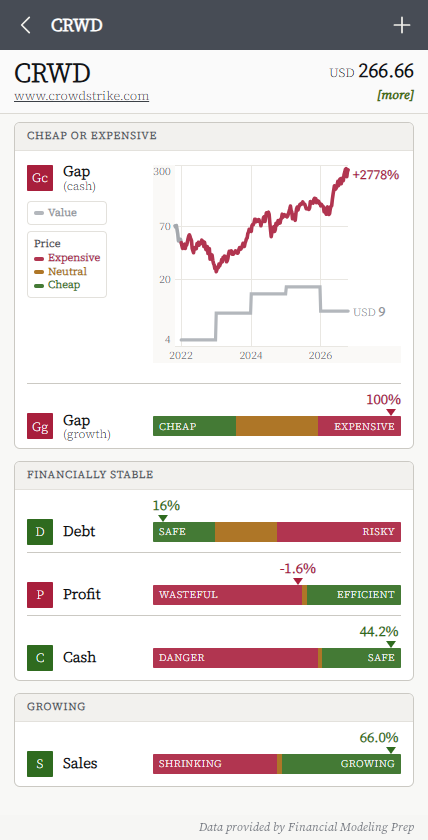
My method asks three things, and the price comes last. Before I look at the price, I want a company that’s financially stable, which to me means it owes little, makes a good profit on the money it puts to work, and brings in cash. I also want it to be growing, even a little.
CrowdStrike owes very little. It has $750 million of bonds that come due in 2029, and at the end of July 2026 it had $5.01 billion in cash. In Bufetico, its debt, the cash it brings in and its sales all come out green, which to me means healthy.
Its profit comes out red. Under the accounting rules every US public company follows, CrowdStrike lost $293.3 million running the business in fiscal 2026. Leave out the $1.097 billion it paid its people in stock, and it would have made money.
In fiscal 2026 its operations brought in $1.612 billion of cash. It spent $371 million on equipment and on software it builds for its own use, so it kept $1.241 billion. Stock pay is most of the reason the cash looks so much better than the loss. No cash leaves the company when it pays people in shares, so the cash flow statement adds that cost back. I count it anyway, because each new share leaves the people who already own CrowdStrike with a smaller piece of it. Subtract the stock pay, and what CrowdStrike kept in fiscal 2026 drops to about $145 million.
Then I look at the price. On October 28, 2026, CrowdStrike closed at $266.66 a share. After a four-for-one stock split in July 2026, there are about 1.024 billion shares, so the whole company was priced at about $273 billion. That’s about 220 years of the cash it kept in fiscal 2026, even before taking out the stock pay. Bufetico looks at the price from two sides. The Gap (cash) puts the price next to the cash CrowdStrike brings in each year, and the Gap (growth) puts it next to how fast the company grows. For CrowdStrike, both are red, and red means expensive.
Where this breaks
One year of cash is a tough yardstick for a company whose sales grow more than 20 percent a year, and CrowdStrike’s cash is growing fast too. Over the 12 months that ended in July 2026, it kept $1.526 billion. The price is about 179 years of that. The Gap (growth) is there for exactly this kind of company, and it’s red as well. And growth doesn’t fix the stock pay, which ate about 88 percent of what CrowdStrike kept in fiscal 2026.
Del Rio’s side of the story comes from his own lawsuit and from one travel site’s account of it. Two courts have ruled against him so far, and the Supreme Court turns down most of the cases it’s asked to hear.
Del Rio’s night in Kona and one paragraph in CrowdStrike’s quarterly report
On October 10, 2026, CrowdStrike told the Supreme Court it wouldn’t file a response to del Rio’s petition. On October 19, the Court asked for one anyway, due November 18, 2026, its docket shows. His lawyers built the petition on one point: del Rio was never a CrowdStrike customer, so a software company with no deal with passengers shouldn’t get the protection Congress gave airlines.
CrowdStrike did make settlement offers to some of its customers over the outage, its quarterly report says. It says the amount is too small to matter to its results, and that its insurance covers all of it. Delta has said it wants more than $500 million, TechRadar reported, and CrowdStrike says its contract caps what it could owe Delta at single-digit millions, The Register reported. For the lawsuits, Delta’s and the passengers’ included, the same quarterly report says a loss is reasonably possible but that CrowdStrike can’t estimate how much. So none of that possible loss is on its books yet.
Bufetico shows the answers to all three questions for CrowdStrike on one screen.
If I owned CrowdStrike, I’d open its next quarterly report, which usually comes out in late November or early December, and read two parts of it. In the note on legal matters, I’d see where del Rio’s petition and Delta’s case stand, and whether CrowdStrike still says it can’t estimate a loss. In the cash flow statement, I’d take the cash from operations, subtract what it spent on equipment and software, then subtract the stock pay (the statement calls it stock-based compensation), and put what’s left next to the same quarter a year earlier.
If you bought CrowdStrike expecting it to keep climbing the way it did in 2026, the fear comes along with the hope, and a drop of 20 or 30 percent hurts twice, because the gain you were counting on goes with it. That’s when people sell for reasons that have nothing to do with the business, or start fixing a method that was fine. You don’t play a concert the week you buy a guitar. Your fingers have to toughen up first, and that takes months of songs that hurt a little. Sitting through a big drop takes emotional muscle, and I build it the same way, with smaller drops first. I keep every position about the same size, so no single stock, however famous, can scare me out of my own rules.
If you own CrowdStrike or you’re about to buy it, the company owes little, brings in a lot of cash and keeps growing fast. But under the accounting rules it still loses money running the business, and once I count the stock pay, it kept only about $145 million of cash in fiscal 2026. And its price sits far above what its cash and its growth support. To me that’s expensive.
You probably filed the outage away as old news. Julio del Rio is still waiting to hear if the Supreme Court will take his case.
Key factsThe numbers and where they come from · 6 November 2026
- In fiscal 2026, which ended January 31, 2026, CrowdStrike’s operations brought in $1.612 billion of cash. It spent $371 million on equipment and software for its own use, which left $1.241 billion, and it booked $1.097 billion of pay in stock (annual report for fiscal 2026).
- In fiscal 2026, CrowdStrike sold $4.812 billion, 22 percent more than a year earlier, and lost $293.3 million from operations (annual report for fiscal 2026). Its sales grew 26 percent in the quarter that ended in July 2026 (second-quarter report).
- In its report for the quarter that ended July 31, 2026, CrowdStrike says a loss from the lawsuits and inquiries over the outage is reasonably possible but that it can’t estimate the amount, and that its settlement offers to some customers are entirely offset by insurance (second-quarter report).
- Julio del Rio and other passengers asked the Supreme Court to hear their case on September 14, 2026. CrowdStrike waived its right to respond on October 10, and on October 19 the Court requested a response, due November 18, 2026 (Supreme Court docket).