 Bufetico

If you own Palantir stock, or you’ve been about to buy it for months, every headline lands in your stomach. Some days it makes you feel smart. Some days it makes you feel late. Amber Retzloff sees Palantir from a different place. Her hospital builds her work schedule with software that runs on it.
Retzloff is 34, a critical care nurse in Florida with a decade at the bedside. She’s also a leader in National Nurses United, the nurses’ union. Her hospital belongs to the HCA hospital chain, and around the end of 2024 it started making nurse schedules with a tool called Timpani. HCA built Timpani with Palantir, on Foundry, Palantir’s software for storing and analyzing data. The tool forecasts how many patients will come in and works out from that who should be on shift, WIRED reported on October 2, 2026. HCA uses it in about 130 of its 190 locations.
Over four months, Retzloff asked for 50 specific 12-hour shifts. More than half the time, the software put her on different ones, often three days in a row.
On some of her shifts, all four of the nurses working with her were junior. As the only senior nurse, she had to make the sickest patients wait while she walked the newer nurses through the milder cases. She told WIRED that HCA is “letting AI dictate.”
HCA tells it differently. Its spokesperson, Harlow Sumerford, said nursing leaders make the final call on schedules, not Timpani. HCA also says that on average the tool puts nurses on 1 percent of the days they asked to have off. That’s a different count from hers. She was talking about the shifts she asked to work. Palantir has said its software only presents information, and that its customers make their own decisions.
Where Palantir’s growth comes from
For Palantir, a hospital chain like HCA counts as a US business customer, and that’s its fastest-growing group. In the second quarter of 2026, Palantir’s revenue grew 93 percent from a year earlier, to $1.935 billion. Its sales to US businesses grew 149 percent, to $764 million, its second-quarter results show. Palantir doesn’t say how much of that comes from HCA.
The three questions I ask
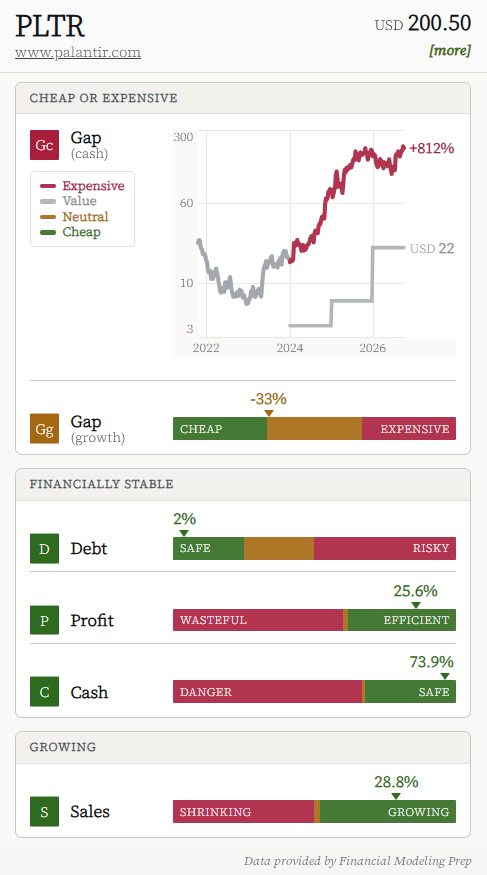
When I look at a company, I go in a fixed order. I start with whether it’s financially stable. For me that means it doesn’t owe much, it makes a good profit on the money it puts in, and it brings in cash. That’s what lets a company ride out a crisis. Next, I ask if it’s growing, even a little. Only then do I ask if it’s cheap or expensive.
Palantir clears the first two easily. It had no debt at the end of June, its quarterly report says. In 2025 its operations brought in $2.134 billion of cash, its fourth-quarter release shows. In Bufetico, its debt, its profit, its cash and its sales all come out green.
Then I look at the price. Palantir’s own measure of the cash left over after its investments, which it calls adjusted free cash flow, came to $2.270 billion in 2025. That’s a bit more than its operations brought in, because Palantir adds back the payroll taxes it pays on the stock it gives its people. At the close on October 15, its shares were $200.50 each, and there are about 2.4 billion of them, so the whole company was priced at about $480 billion. If the business brought in that much cash every single year, it would take more than 200 years of it to add up to the price. It’s the same idea as a P/E ratio, with cash in place of profit. In Bufetico, the Gap (cash), which puts the price next to the cash Palantir brings in each year, is red.
Then there’s the stock pay. In 2025 Palantir booked $684 million of pay in stock, and the adjusted figure doesn’t count it as a cost, because no cash leaves the company for it. I count it anyway. Every share Palantir hands an employee makes the other owners’ slice of the business a little smaller. Take it out, and Palantir’s 2025 cash comes to about $1.6 billion. The price is about 300 years of that.
Where this breaks
One year of cash is a pretty tough yardstick for a company growing this fast. Bufetico has a second measure for cheap or expensive, one that weighs growth, and it puts Palantir somewhere between cheap and expensive. Palantir expects adjusted free cash flow of $4.5 billion to $4.7 billion in 2026. At the top of that range, the price is about 100 years of it. For the price to come down to about 25 years of cash, that cash would have to double twice more after 2026. I have no way to know if it will. I wrote about the difference between price and value with Meta, another company people love for its growth.
Retzloff’s story has its limits too. It comes from one article. She’s a union leader, and HCA disputes what she says.
Retzloff’s union and one sentence in Palantir’s risks
In late August 2026, nurses from Retzloff’s union protested Palantir’s work in hospitals outside its former headquarters in Palo Alto and in seven other cities, KQED reported. Palantir had already changed one sentence in its filings months earlier.
In its annual report for 2025, Palantir’s warning about activists said they protest “at our properties and other locations.” In its first quarterly report of 2026, filed in May, the sentence grew: “including at the premises of our customers, partners, and third-party service providers.” The sentence after it is new too. It says that activity has, in some cases, disrupted operations and “caused third parties to terminate or seek to limit their relationship with us.” Palantir doesn’t say who, or why.
The price needs many more years of fast growth. The fastest growth comes from US businesses like HCA. And Palantir itself now writes that protests reach its customers’ doors, and that some of the companies it works with have pulled back.
This is Palantir in Bufetico, with all three questions on one screen.
If I owned Palantir, I’d open its next quarterly report and read the paragraph about activists first, to see if it grows again. When the full-year numbers come out, I’d put two lines of the cash flow statement side by side, the cash from operations and the stock-based compensation, and look at what’s left.
If you own Palantir or you’re about to buy it, the business is financially stable and growing. But its price sits way above what Palantir is worth, going by the cash it brings in each year, and to me that’s expensive.
Palantir will keep showing up in the news, and some of it will land in your stomach again. Now you know which page to open when it does.
Key factsThe numbers and where they come from · 16 October 2026
- In the second quarter of 2026, Palantir’s revenue grew 93 percent from a year earlier, to $1.935 billion, and its sales to US businesses grew 149 percent, to $764 million (second-quarter results).
- In 2025, Palantir reported $2.270 billion of adjusted free cash flow and booked $684 million of pay in stock (fourth-quarter release).
- For 2026, Palantir expects adjusted free cash flow of $4.5 billion to $4.7 billion (second-quarter results).
- HCA uses Timpani, a scheduling tool it built with Palantir on Palantir’s Foundry software, in about 130 of its 190 locations (WIRED, October 2, 2026).